
5 Nutrient-Dense Foods That Beat Any Supplement Stack
Beef liver, oysters, sardines, pasture eggs, raw cacao. The five whole foods that out-perform almost anything you can buy in a capsule.
If you want maximum nutrition per pound, per calorie, per minute of effort, the five foods that out-perform almost any supplement stack on Earth are beef liver, oysters, oily fish, pasture-raised eggs, and raw cacao. Real food, ancestral diet, no capsules, and most of it sitting on the shelf at any decent fishmonger or supermarket.
A note on what we're doing here: we're picking single-ingredient whole foods that punch dramatically above their weight on multiple nutrients at once. Not "superfoods" in the marketing sense. Foods our great-grandparents would have recognised, eaten regularly, and not paid £14.99 for in a green powder.
1. Beef liver, the original multivitamin
Evidence: Strong100 grams of beef liver contains more vitamin A than almost any other food on Earth, more B12 than any whole food, plus dense iron, copper, choline, riboflavin, folate, and zinc [1]. It is, almost literally, what a capsule manufacturer would design if they were trying to copy nature.
It tastes strong. Some people love it; most need to start by hiding it. Blend 100g of fresh organic liver into a kilo of mince. You'll never taste it, and your meatballs will deliver the nutrient profile of a six-supplement stack.
- How often: 100-200g once a week
- Source: grass-fed, organic if at all possible (the liver is the body's filter, quality matters)
- Avoid: if you eat a lot of liver AND take a high-dose vitamin A supplement, you can overdo it. Liver alone is well within safe range.
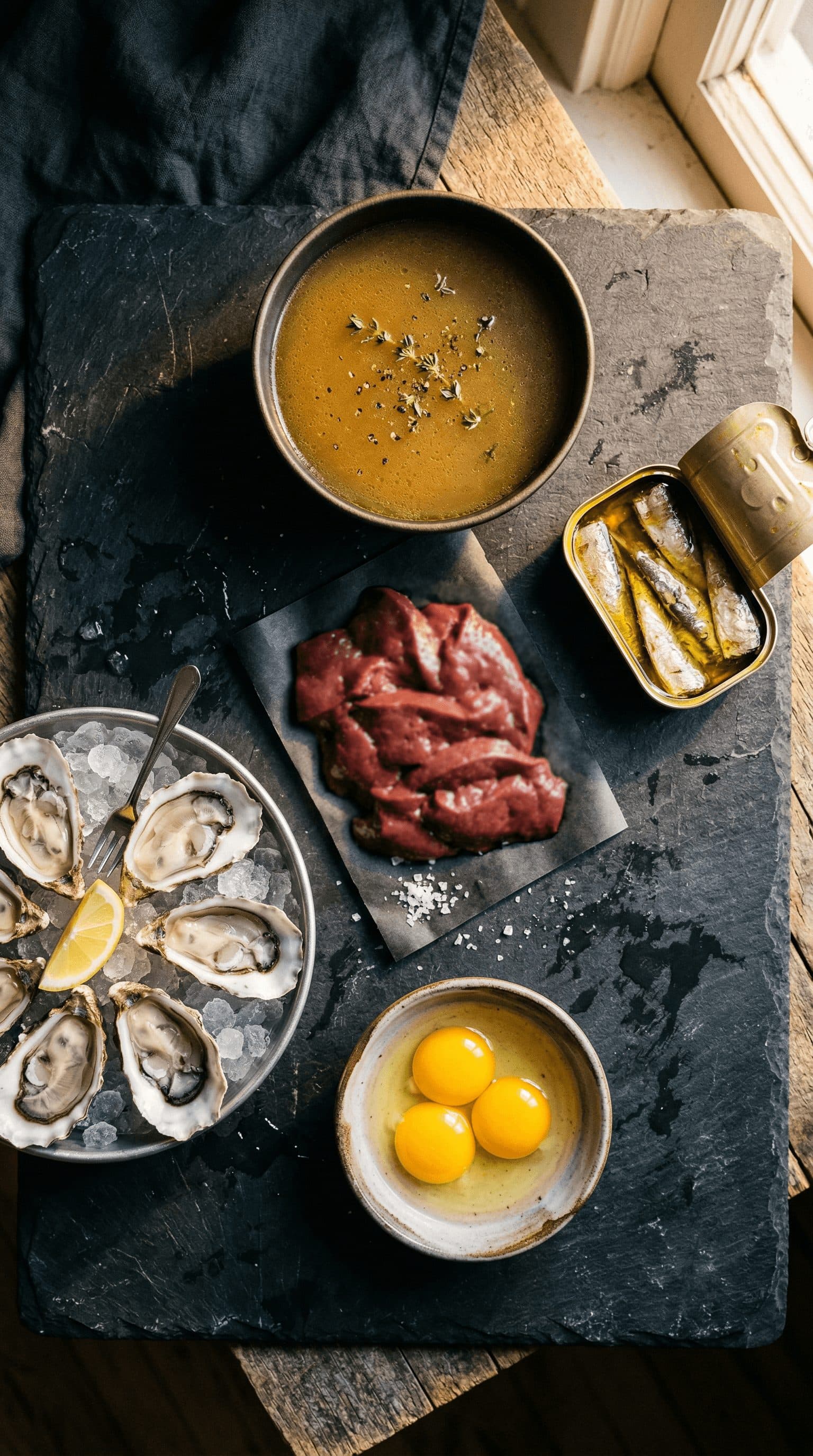
2. Oysters, the zinc and B12 pocket battleship
Evidence: StrongA standard 100g serving of oysters contains roughly 8x your daily zinc requirement and 6-7x your daily B12, plus substantial doses of selenium, iron, and copper [2]. Almost nothing else on a food label compares.
If fresh oysters are out of reach (cost, taste, geography), tinned smoked oysters are an outstanding shortcut. Cheap, shelf-stable, and the smoking process actually concentrates the minerals. Open a tin, eat them on rice cakes, move on with your day.
- How often: weekly
- Form: fresh when accessible, tinned smoked the rest of the time
- Don't: worry about the saturated-fat-in-oysters non-issue. They're remarkably lean.
3. Oily fish, sardines or mackerel before salmon
Evidence: StrongSardines and mackerel beat salmon on most nutrient metrics, cost a fraction, and come pre-packaged in a tin. Wild sardines deliver large doses of EPA + DHA omega-3 (the bit that actually matters [4]), plus calcium (you eat the bones), vitamin D, B12, selenium, and CoQ10. Mackerel is similar.
Salmon is fine. We just don't think it deserves the price premium when sardines and mackerel exist.
- How often: 2-3 times a week
- Source: wild-caught when possible. Tinned in water or olive oil.
- Don't: buy farmed salmon as your primary omega-3 source. The fatty-acid profile in farmed fish is degraded by the unnatural feed.
4. Pasture-raised eggs, the most underrated food on Earth
Evidence: StrongPasture-raised eggs deliver complete protein, all nine essential amino acids, plus choline (critical for liver and brain function and chronically under-consumed [3]), vitamin D, vitamin K2, lutein, zeaxanthin, and bioavailable B12. The yolk is where almost all of this lives. Egg-whites-only is an aesthetic choice, not a nutritional one.
The "eggs are bad for cholesterol" framing has been comprehensively walked back over the last decade [6]. Eat the yolks.
- How often: 2-4 daily for most people
- Source: pasture-raised, not "free range" (which legally means almost nothing). Look for orange, almost red yolks.
- Don't: spend the money on "omega-3 enriched eggs", it's mostly marketing. Just buy real pasture-raised.
5. Raw cacao, the one indulgence that's actually a nutrient
Studies suggestRaw cacao (the unprocessed bean, not the sugar-bomb chocolate it usually becomes) is one of the highest-flavanol foods on the planet. The flavanols are linked in research to better cerebral blood flow, improved cognitive function, and lower blood pressure [5]. Plus it tastes great.
Avoid milk chocolate, sugar-bombed dark chocolate, and the "sugar-free" stuff loaded with seed oils and synthetic sweeteners. We want the actual bean.
- How often: 10-20g daily
- Form: 85%+ dark chocolate (look for short ingredient lists), or raw cacao nibs sprinkled on yogurt
- Don't: assume all dark chocolate qualifies. Read the back. If sunflower oil or sugar is in the top three, it's not it.
What to leave alone
| Food | Why it's not on this list |
|---|---|
| Kale | Decent but vastly over-hyped. Your spinach is fine. |
| Quinoa | Fine if you tolerate it; not nutritionally remarkable |
| Chia / flax / hemp seeds | Plant-source omega-3 (ALA) converts poorly to EPA/DHA |
| Acai / goji / "exotic superfoods" | Marketing arbitrage. Beef liver is cheaper and stronger |
| Protein powder | Use it if convenient; not foundational |
The bottom line
If you eat liver weekly, oysters weekly, sardines 2-3 times a week, pasture eggs most days, and a square of dark chocolate after dinner, you have covered more nutritional ground than 95% of supplement stacks. None of this is exotic. None of this is expensive. All of it is what humans were eating for thousands of years before we decided we needed a capsule.
Start with eggs. Add tinned sardines. Try one oyster. Build from there.
References
- [1]USDA FoodData Central, Beef liver, raw — USDA Agricultural Research Service (2019)
- [2]USDA FoodData Central, Oysters, eastern, raw — USDA Agricultural Research Service (2019)
- [3]Choline: an essential nutrient for public health — Nutrition Reviews (2009)
- [4]Marine omega-3 supplementation and cardiovascular disease (VITAL trial) — JAMA Cardiology (2019)
- [5]Cocoa flavanols and cognitive function, neuroimaging study — Hippocampus (2020)
- [6]Egg consumption and cardiovascular events — BMJ (2020)
- [7]Bioavailability of haem and non-haem iron — American Journal of Clinical Nutrition (2010)
The TFC letter
Get the next one before the algorithm decides for you.
One email when we publish something genuinely useful. Written like this post: cited, honest about the evidence, no spam.
Keep reading
Educational content. Not medical advice. See our terms for the full disclaimer.