
5 Supplements I'd Take If I Was Starting From Zero
If you're starting from scratch, these are the five supplements that move the needle for almost everyone. Real food first, but this is the smart insurance policy.
If you're starting from zero, the five supplements that actually move the needle for almost everyone are creatine, magnesium glycinate, omega-3, vitamin D3 (with K2), and zinc. Real food first: oysters, oily fish, beef liver, sunlight. But these five are the insurance policy for the gaps modern life almost guarantees you'll have.
Five things to know before we go through them: every claim below is cited at the foot of the post; we've taken every one of these ourselves; we picked them for boring reasons (good evidence, low risk, real-world results); we never recommend brands we haven't tested; and none of this is medical advice.
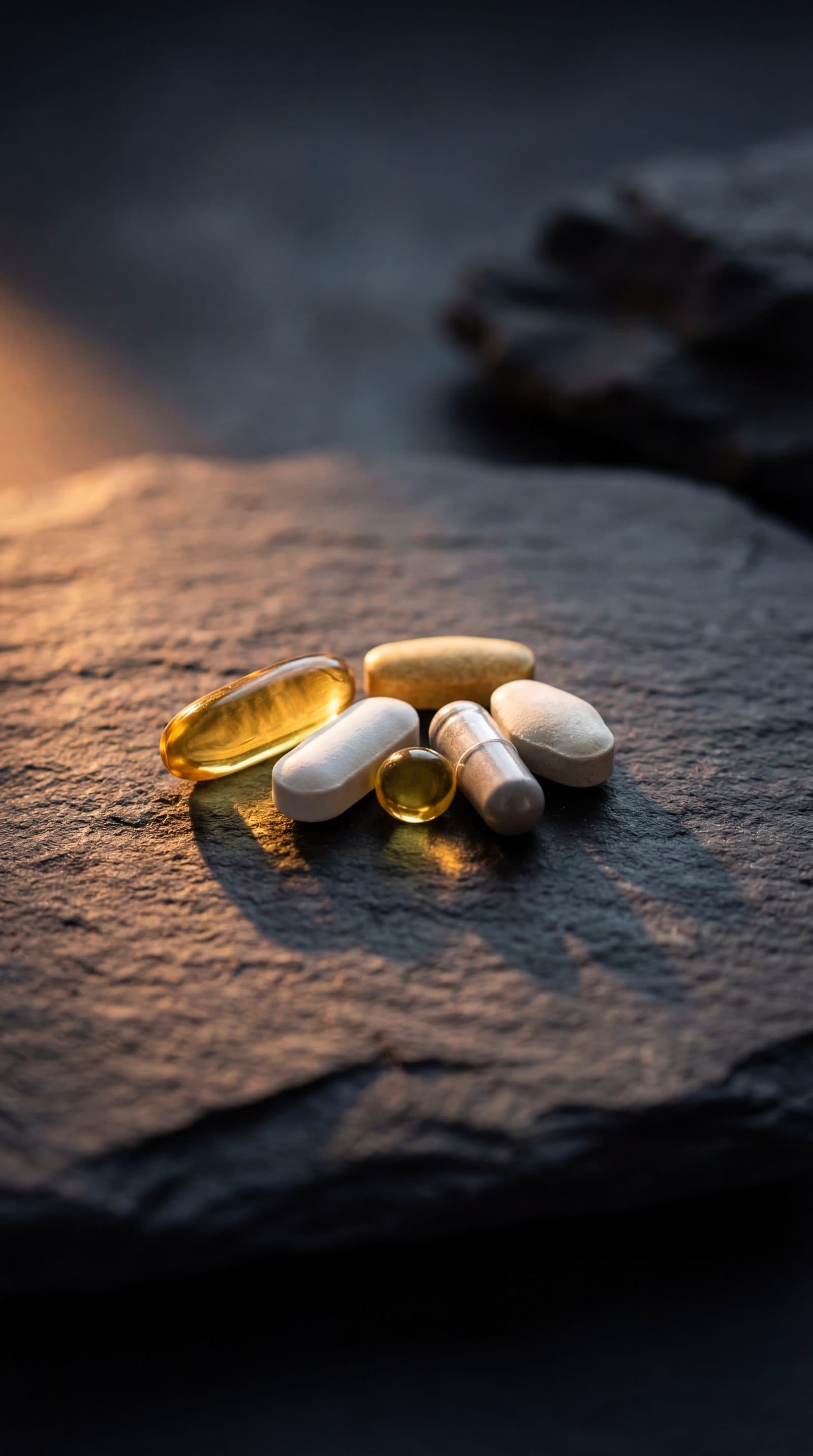
The "real food first" rule
Before any of this: a tin of oysters, a tin of sardines, eight minutes of midday sun on bare arms, and a portion of grass-fed liver a week will out-perform a stack of capsules every time. Supplements are not a permission slip to eat badly. They're a fix for what modern food, modern light, and modern soils can't reliably give you.
That said, almost nobody is doing all of that consistently. So here are the five we'd reach for before anything else.
1. Creatine
Evidence: StrongCreatine is the most-studied supplement in human history and probably the most under-rated. Most people associate it with bigger biceps. Fine, that's real [1]. The bit you don't hear enough: it also supports cognition, memory, and resilience to mental fatigue [2].
Your body makes about half the creatine it needs and gets the rest from meat. If you eat a lot of beef and don't train hard, you might get away without it. Everyone else benefits.
- Form: creatine monohydrate. Anything else is marketing.
- Dose: 5 g/day. Skip the "loading phase". Pointless.
- When: any time. Consistency matters more than timing.
- Look for: Creapure label. It's the gold-standard German-manufactured monohydrate.
5g
ISSN consensus position, 2017
2. Magnesium glycinate
Evidence: StrongSubclinical magnesium deficiency is one of the most common nutritional gaps in the developed world [3]. Modern soils are depleted, processed food strips it out, and stress burns through it fast. Symptoms: poor sleep, restless legs, muscle cramps, low-level anxiety, that 3am wake-up [4].
The form matters more than the dose. Magnesium oxide (the cheap kind in most multis) is poorly absorbed. Glycinate is the version we'd take.
- Form: magnesium glycinate (sometimes called bisglycinate).
- Dose: 200-400 mg elemental magnesium, in the evening.
- When: 30-60 minutes before bed. Helps almost everyone sleep deeper.
- Avoid: magnesium oxide, magnesium citrate (laxative-heavy), proprietary "blends".
3. Omega-3 (EPA + DHA)
Evidence: StrongThe modern Western diet has flipped the omega-6 to omega-3 ratio from roughly 1:1 to 4:1 (ancestral) to somewhere around 20:1. That ratio is now associated with chronic inflammation, cardiovascular risk, and worse outcomes across most disease categories [5].
If you eat oily fish three times a week, wild salmon, mackerel, sardines, you don't need this. Almost no one does that consistently.
- Form: triglyceride-form fish oil OR cod liver oil. Krill oil is fine but expensive.
- Dose: aim for 2 g EPA+DHA combined per day.
- When: with a meal containing fat (better absorption).
- Look for: independent third-party purity certification (IFOS or similar). Rancid fish oil is worse than no fish oil.
4. Vitamin D3 (with K2)
Evidence: StrongVitamin D supplementation reduces all-cause mortality in deficient populations [6]. The catch: most people are deficient, especially anywhere north of latitude 35°. In the UK, more than 1 in 5 adults is clinically deficient through winter, and another large chunk is "insufficient" [9].
We always pair D3 with K2 (specifically MK-7) because they work together: D3 increases calcium absorption; K2 directs that calcium into bones and away from arteries.
- Form: D3 (cholecalciferol) + K2 (MK-7). Single capsule with both.
- Dose: 2,000-4,000 IU D3 + 100-200 mcg K2/day. Test bloods if you can.
- When: with a fatty meal. D3 is fat-soluble.
- Caveat: sun is still better. We aim for daily midday exposure first, supplement second.
5. Zinc
Evidence: StrongZinc is the unsexy mineral that runs about 300 enzyme reactions in your body, including the ones that make testosterone, regulate immune function, and repair tissue [7]. Around 17% of the global population is deficient [8], higher in vegetarians and people who train hard.
If you eat oysters weekly, skip this. Otherwise, a small daily dose is cheap insurance.

- Form: zinc bisglycinate or zinc picolinate. Avoid zinc oxide.
- Dose: 15-30 mg/day. Don't go higher long-term, competes with copper absorption.
- When: with food. Empty stomach can cause nausea.
- Don't take: at the same time as magnesium (compete for absorption, space them out).
What we don't take, and why
| Supplement | Why we skip it |
|---|---|
| Multivitamins | Cheap forms, nutrients you don't need, false sense of security |
| BCAAs | Pointless if you eat enough complete protein |
| Pre-workout | Mostly caffeine and theatre |
| Greens powders | Eat actual vegetables |
| Most adaptogens | Mixed evidence, expensive, not foundational |
| Collagen | Decent for skin and joints, but a layer-in, not a starter |
How to actually buy these
A few practical rules, learned the hard way:
- Check the back of the label, not the front. Fillers, magnesium stearate, "proprietary blends", and titanium dioxide are red flags. The fewer ingredients, the better.
- Single-ingredient supplements over blends. You want to know what you're taking and why.
- Independent testing matters. Look for COA (Certificate of Analysis) availability or third-party verification.
- Cheap supplements are usually cheap for a reason. This is one place where price often correlates with quality.
- Don't take everything at once. Add one, give it a month, see how you feel, add the next.
The bottom line
These five are not magic. They're the foundation. Real food, sunlight, sleep, and movement do most of the work. Supplements close the predictable gaps modern life creates and let the real-food, real-sun, real-sleep stack actually do its job.
Start with one. Probably magnesium if your sleep is rubbish, or D3 if you're in a Northern Hemisphere winter. See how you feel for a month. Add the next.
References
- [1]Creatine supplementation in health and disease — Journal of the International Society of Sports Nutrition (2021)
- [2]Effects of creatine on cognitive function in healthy adults — Experimental Brain Research (2018)
- [3]Subclinical magnesium deficiency: a principal driver of cardiovascular disease — Open Heart (2018)
- [4]The importance of magnesium in clinical healthcare — Scientifica (2017)
- [5]Marine omega-3 supplementation and cardiovascular disease — JAMA Cardiology (VITAL trial) (2019)
- [6]Vitamin D supplementation and total mortality — Cochrane Database of Systematic Reviews (2014)
- [7]Zinc and immune function: the biological basis of altered resistance to infection — American Journal of Clinical Nutrition (1998)
- [8]Estimating the global prevalence of zinc deficiency from national food supply data — PLoS ONE (Wessells & Brown) (2012)
- [9]Vitamin D status of the British general population — British Journal of Nutrition (2018)
The TFC letter
Get the next one before the algorithm decides for you.
One email when we publish something genuinely useful. Written like this post: cited, honest about the evidence, no spam.
Keep reading
Educational content. Not medical advice. See our terms for the full disclaimer.